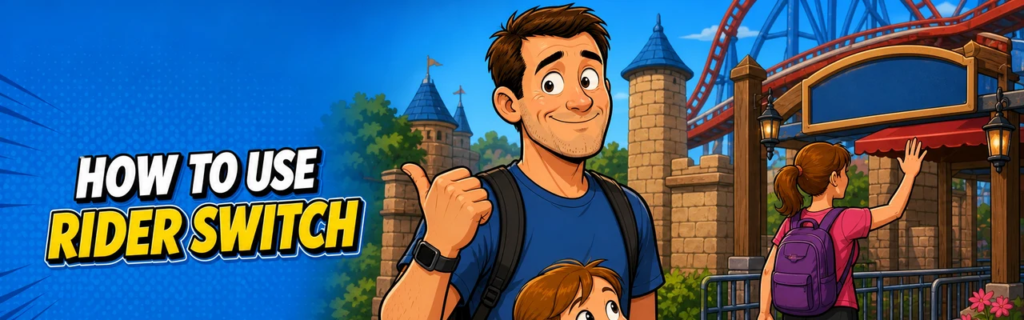
How to Use Rider Switch at Disney World: A Dad’s Easy Step-by-Step Guide
Dad Tip
Choose a specific reunion point before the first group enters the queue. “Near the ride” stops being useful when several thousand people are also near the ride.
Dad Strategy
Use the first group’s wait for a snack, restroom stop, stroller break, or nearby gentle attraction. Rider Switch saves the most time when the waiting adult has a simple plan.
Important
Bring the entire party—including the non-riding guest—to the attraction entrance before anyone enters the queue. Procedures can change, so confirm the handoff and return rules with the Cast Member.
Every Disney dad eventually faces the same tactical problem. One child is tall enough—and extremely ready—to ride. Another child is too short, too nervous, or simply wants nothing to do with being launched backward through the dark. One adult wants to ride, the other adult wants to ride, and nobody wants to spend the afternoon standing in the same line twice. Let us show you how to Use Rider Switch at Disney World.
That is exactly why Rider Switch exists.
Rider Switch allows the adults in a party to take turns experiencing an attraction while one adult remains with a child or another guest who cannot wait outside the queue alone. The second adult can then ride without waiting through the full standby line again. Used correctly, it keeps both parents in the action and prevents a height requirement from turning into a family negotiation worthy of the United Nations.
The process is not difficult, but it is not completely automatic either. You need to speak with a Cast Member before the first group enters the queue, make sure everyone who needs to be there is present, and understand who will ride during each turn.
What Rider Switch Is
Disney describes Rider Switch as a service that lets guests take turns experiencing an attraction. The first group enters the attraction queue while the waiting adult remains outside with the guest who is not riding. When the first group returns, the waiting adult uses the Rider Switch entitlement to enter through the return entrance instead of joining the regular standby line from the beginning.
Rider Switch is available at most Disney World attractions where it is useful, particularly rides with height requirements. It may also be appropriate when a guest does not plan to ride but cannot wait alone, when a guest has a service animal that cannot board, or when a guest cannot experience the queue because of the nature of that queue and their specific needs.
It is important to understand what Rider Switch does not do. It does not let the whole family skip the line. It does not create immediate front-of-line access. The first group still waits in the applicable standby or Lightning Lane queue, and the second group may still have a short wait when returning.
Think of it as a family handoff system, not a secret ride hack.
Who Can Use Rider Switch?
The most common Rider Switch situation involves a child who does not meet an attraction’s height requirement. Disney World measures children at the entrance and may measure them again before boarding. Shoes, optimism, and Dad’s eyewitness testimony do not change the measuring stick.
Rider Switch can also help when a child is tall enough but does not want to ride, provided that child cannot wait alone outside the queue. The same general idea applies to another guest who does not plan to experience the attraction and cannot safely remain by themselves.
Your entire party should approach the Cast Member at the attraction entrance together. This gives the Cast Member an opportunity to see the non-riding guest, confirm that Rider Switch is appropriate, explain the current procedure, and identify the adults who will ride during the second turn.
Procedures can vary by attraction and can change, so the Cast Member at the entrance always gets the final word.
How to Use Rider Switch at Disney World
Start by bringing the entire group to the attraction entrance. Do this before anyone scans into a Lightning Lane or disappears into the standby queue. Tell the greeting Cast Member that your party would like to use Rider Switch.
The Cast Member will confirm your group’s situation and explain where the waiting adult should go. The adult who will ride second will typically have a Rider Switch entitlement associated with their admission media in Disney’s system. Make sure the correct MagicBand, ticket card, or Disney MagicMobile pass is used.
The first riding group then enters the appropriate queue. If they are using standby, they wait in standby. If they have valid Lightning Lane access, they follow the Lightning Lane procedure. Rider Switch by itself does not convert the first group’s standby wait into Lightning Lane access.
Meanwhile, the second adult stays with the non-riding child or guest. This is the useful part of the system: you are not trapped beside the attraction entrance. You can find a snack, use the restroom, browse a nearby shop, cool down indoors, or let a toddler inspect the same fountain for 25 minutes because apparently that is now the main attraction.
When the first group finishes, the adults meet and exchange responsibility for the non-riding guest. The second adult returns to the attraction and uses the Rider Switch entitlement as directed. Disney commonly allows the returning adult to bring a limited number of eligible companions, which may let an older child ride again. Because party limits and procedures can change, confirm the exact number with the Cast Member who sets up your switch.
Can an Older Child Ride Twice?
Often, yes—and this is one of the best parts of Rider Switch for families with children of different heights.
Suppose Dad rides first with an older child while Mom stays with the younger child. When Dad returns, Mom may be able to ride with the older child as her companion. The older child gets a second ride while each adult gets one turn.
Do not promise that second ride until the Cast Member confirms it. Disney controls how many guests can accompany the returning adult, and the rules used at the attraction that day are the rules that matter. “A guy on the internet said my kid gets two rides” is rarely the winning argument Dad imagines it will be.
Rider Switch With Lightning Lane
Rider Switch and Lightning Lane are separate systems. Rider Switch manages which adult waits with the non-riding guest. Lightning Lane determines which queue eligible riders may use.
If your first riding group wants to enter through Lightning Lane, every person in that group needs the required Lightning Lane access for that attraction. The returning Rider Switch group follows the instructions provided by the Cast Member. Do not assume one Lightning Lane purchase or selection covers adults taking both turns.
This distinction matters when planning your day. Rider Switch saves the second adult from repeating the full standby wait, but it does not erase the first group’s queue. On a busy day, the family should still choose attractions and Lightning Lane selections strategically.
For the technology side of that planning, see our guide to using Lightning Lane Multi Pass at Disney World.
Where Should the Waiting Adult Go?
The best waiting location depends on the attraction, the weather, and the mood of the child who is sitting out.
Ask the entrance Cast Member approximately how long the first group should take and where the second group returns. Then choose something close enough that you can reunite without crossing half the park. Nearby restrooms, quick-service restaurants, shaded seating, play areas, shops, and gentle attractions are all useful options.
Avoid sending the waiting adult on an ambitious side quest. If the first group finishes and one parent is three lands away with a sleeping toddler, Rider Switch has not saved time. It has merely created a family scavenger hunt.
Pick a specific reunion point before separating. “Near the ride” sounds precise until several thousand other people are also near the ride.
The Best Attractions for Rider Switch
Rider Switch is most valuable at popular attractions with height requirements and substantial waits. Disney’s official Rider Switch page lists participating attractions across the four theme parks, including major rides such as TRON Lightcycle / Run, Seven Dwarfs Mine Train, Guardians of the Galaxy: Cosmic Rewind, Test Track, Star Wars: Rise of the Resistance, Slinky Dog Dash, Avatar Flight of Passage, and Expedition Everest.
The participating list can change as attractions open, close, or adjust their procedures. Check Disney’s official Rider Switch page before your trip and confirm availability with the entrance Cast Member on the day you visit.
Rider Switch may be less valuable when the standby wait is already short or when the family could enjoy a nearby attraction together instead. A technically perfect handoff is not always the best use of precious park time.
Dad Strategy: Build Rider Switch Into the Plan
Do not wait until you reach the front of an attraction to decide who is riding first. Make that call while walking there.
The adult who cares most about the attraction can ride first if there is any chance the ride will temporarily close later. On the other hand, it can be smarter for the adult accompanying the older child to go first while the other adult handles a snack, bathroom trip, or stroller break with the younger child.
Use the first group’s wait to accomplish something useful for the non-rider. A meal, diaper change, nap, cooling break, or low-key character stop can turn “waiting for Dad” into part of the vacation.
Also account for the total time. Rider Switch prevents two full standby waits, but the family still completes two ride cycles. On attractions with long preshows or lengthy experiences, the entire handoff can take a while. If your next dining reservation begins in 30 minutes, this is not the moment to test the limits of family logistics.
Common Rider Switch Mistakes
The biggest mistake is splitting up before speaking with the entrance Cast Member. If the non-riding child is already elsewhere in the park, the Cast Member may not be able to verify the situation or set up the service.
Another mistake is assuming Rider Switch means every rider can use Lightning Lane. The queue access for the first group remains subject to normal eligibility rules.
Families also get into trouble when they fail to confirm which adult received the Rider Switch entitlement, how many companions may return, or when the entitlement expires. Take ten seconds to repeat the plan back to the Cast Member before leaving the entrance.
Finally, do not frame Rider Switch as proof that the smaller child is missing out. Give the waiting child a specific alternative—snack mission, character hunt, quiet ride, or special time with one parent. A child who feels included is much less likely to greet the returning riders like they have committed an unforgivable betrayal.
Is Rider Switch Worth Using?
For families with a baby, toddler, cautious child, or children of different heights, absolutely. Rider Switch lets adults experience headline attractions without forcing the non-rider through an unsuitable queue or making the family wait in the same line twice.
The service works best when you treat it as part of your touring plan rather than something to figure out at the entrance. Know which attractions matter most, decide who rides first, choose a nearby waiting activity, and set a precise reunion point.
Disney World with children is always going to require some improvisation. Rider Switch simply makes the improvisation feel more like a plan and less like Dad is attempting to coordinate air traffic from beside a stroller.
Before your trip, review Disney’s official Rider Switch information and verify the current procedure with the Cast Member at each attraction.
Rider Switch Quick Checklist
- Bring the entire party, including the non-riding guest, to the attraction entrance.
- Tell the entrance Cast Member that you want to use Rider Switch.
- Confirm which guests will ride first and which adult will ride second.
- Make sure the correct admission media receives the Rider Switch entitlement.
- Ask how many companions may join the returning adult.
- Confirm where the second group returns and whether there is a time limit.
- Choose a specific nearby reunion point before separating.
- Verify that first-group riders have any required Lightning Lane access.
- Give the non-riding child a worthwhile waiting activity.
- Recheck current attraction participation and procedures on the day of your visit.
Discover more from Disney World for Dads
Subscribe to get the latest posts sent to your email.